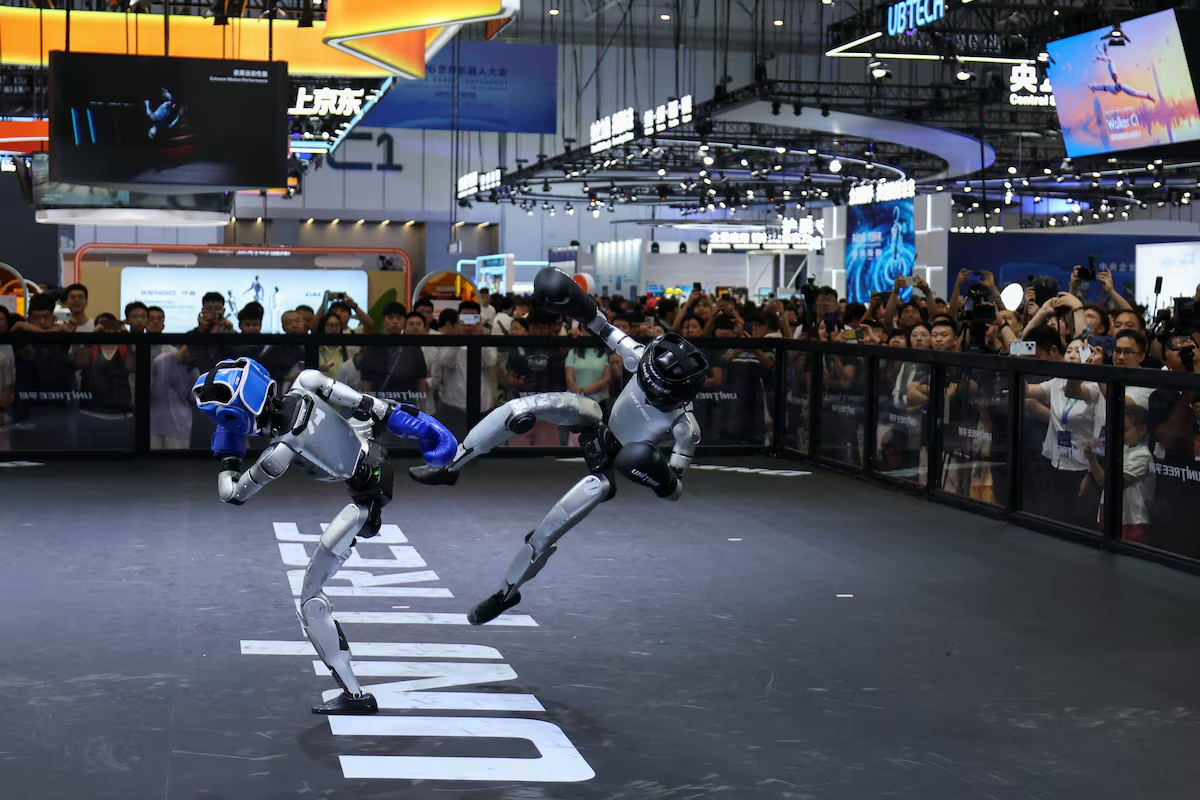
BEIJING, Aug. 19, 2026 — China’s rapidly expanding humanoid-robot industry is trying to move beyond spectacular demonstrations of robots dancing, fighting and performing acrobatics, with manufacturers increasingly focused on proving that the machines can perform useful commercial work.
More than 300 companies, mostly Chinese, are taking part in the World Robot Conference in Beijing, showcasing more than 2,000 robotic products and launching over 150 new products. Demonstrations include humanoid robots sorting parcels, packing mobile phones and performing household tasks.
The change in emphasis reflects a growing challenge for the industry: investors and customers increasingly want to know whether humanoid robots can generate real economic value rather than simply attract attention at exhibitions.
From demonstrations to factories
Several companies at the Beijing conference presented robots already being tested or deployed in industrial environments.
Leju demonstrated humanoid robots moving crates and sorting small objects. The company said its machines are being used in European factories and Chinese automobile plants for tasks such as moving boxes and loading components.
Robotera showed a humanoid robot sorting parcels. The company said more than 100 of its parcel-sorting robots have been deployed in 15 warehouses in China, including at China Post facilities.
DexForce demonstrated robots packing mobile phones into boxes on an assembly line. According to the company, its robots have been operating since early this year at a Lens Technology factory, a supplier to companies including Apple and Huawei.
The company says its robots can operate with millimetre-level precision and identify mistakes, such as a phone being positioned incorrectly.
The appeal is particularly strong for repetitive jobs. Nicole Yang of DexForce said that while humans remain highly dexterous, workers are often unwilling to spend long periods performing monotonous factory tasks.
Home robots face a tougher challenge
Humanoid robots intended for household use are also moving toward wider testing, although commercialisation remains further away.
X Square Robot, which focuses on household chores, has conducted short-term trials in homes. Its longest deployment so far has lasted about a month, while the company plans to test robots in hundreds of homes during 2026 before gradually moving toward commercialisation in 2027.
The home environment presents a much more difficult challenge than a controlled factory. Robots must deal with unpredictable surroundings, different furniture, objects and human behaviour while carrying out a wide variety of tasks.
Huge investor enthusiasm
The industry’s commercial ambitions are being accompanied by enormous investor interest.
Unitree, one of China’s best-known humanoid-robot manufacturers, made its Shanghai stock-market debut on Wednesday. Its shares surged more than fivefold from the IPO price, giving the company a valuation of roughly $50 billion at the close. The company raised about $900 million in its IPO, which attracted extraordinary retail demand.
The success has encouraged other robotics companies to consider going public. Lumos Robotics said it is considering a stock-market listing, while Chery Automobile’s robotics division, AiMOGA Robotics, is also preparing for a potential IPO as it seeks funding for expansion.
China dominates humanoid shipments
The scale of China’s robotics push is reflected in shipment figures.
Morgan Stanley, citing Smart Analytics Global data, estimated that global humanoid-robot shipments increased 272% in the first half of 2026 to around 19,000 units. Chinese companies accounted for approximately 97% of those shipments.
But the figures also reveal the industry’s weakness: around 65% of shipments were still destined for entertainment, education, research and data collection rather than productive commercial applications.
That means the next stage of the industry’s development will depend less on how impressive a robot looks and more on whether it can reliably perform a job at a competitive cost.
Nvidia’s presence highlights global interest
The Beijing conference also attracted international attention.
Madison Huang, a senior Nvidia executive responsible for marketing physical-AI platforms and the daughter of Nvidia CEO Jensen Huang, made an unannounced visit to the event. She watched robot demonstrations and examined technology used in companion robots.
Her visit came despite continuing U.S.-China tensions and American restrictions on advanced semiconductor exports to China.
RealSense, a U.S. company producing vision systems for robots, was among the relatively few foreign exhibitors. The company said China had become a strategically important market for robotics and that it was expanding manufacturing capacity and sales partnerships there.
Government support
Chinese officials are also portraying robotics as an important part of the country’s future economic development.
Vice Minister of Industry and Information Technology Xin Guobin said robotics had become an important force in China’s economic and social development, according to state-backed financial outlet Cailianshe.
Beijing’s support comes as China seeks leadership in artificial intelligence, advanced manufacturing and other strategic technologies.
The real test: productivity
Despite the excitement, the industry still faces a major commercial test.
Humanoid robots remain expensive and technically difficult to operate reliably. A machine that can perform a spectacular backflip or dance routine is not necessarily capable of working an eight-hour shift, handling unpredictable objects or performing tasks cheaply enough to justify replacing a human worker.
Industry participants therefore increasingly believe that successful companies will be those capable of putting robots into genuine production environments.
RealSense’s Mike Nielsen said companies that succeed will be those able to deploy robots in active production settings. He also pointed to China’s unusually rapid development cycles: robotic products can evolve in roughly six to eight months rather than the three- to four-year cycles common in many traditional industries.
What comes next
China’s humanoid-robot sector is entering a new phase. The first stage was largely about demonstrating what robots could do; the next is about demonstrating that they can do useful work consistently, safely and economically.
Factories, warehouses and logistics centres are likely to be among the earliest large-scale applications because these environments offer more predictable tasks than homes.
If Chinese manufacturers can lower costs while improving dexterity, autonomy and reliability, the country’s enormous manufacturing base could give its robotics companies an advantage in turning experimental humanoids into mass-market machines.
But the industry’s current shipment figures also show that the transition is far from complete. Much of the market remains focused on demonstrations, research and data collection.
The coming years will therefore determine whether humanoid robots become a genuinely productive industrial technology—or remain, for the time being, impressive machines searching for a practical business case.